A burning smell near a socket needs prompt attention.
A homeowner in a chalet bungalow on Tavistock Road, Fleet, noticed a burning smell from a portable oil-filled heater in their lounge. When they tried to disconnect it, the plug would not come out of the socket.
The customer did the right thing. They switched off the heater and the socket at the wall, stopped using the appliance and contacted Wessex Electrical Services.
When we attended, the heater plug remained stuck in the socket. We isolated the circuit before dismantling the damaged equipment and checking whether the heat had affected the fixed wiring.
What had happened to the heater plug and socket?
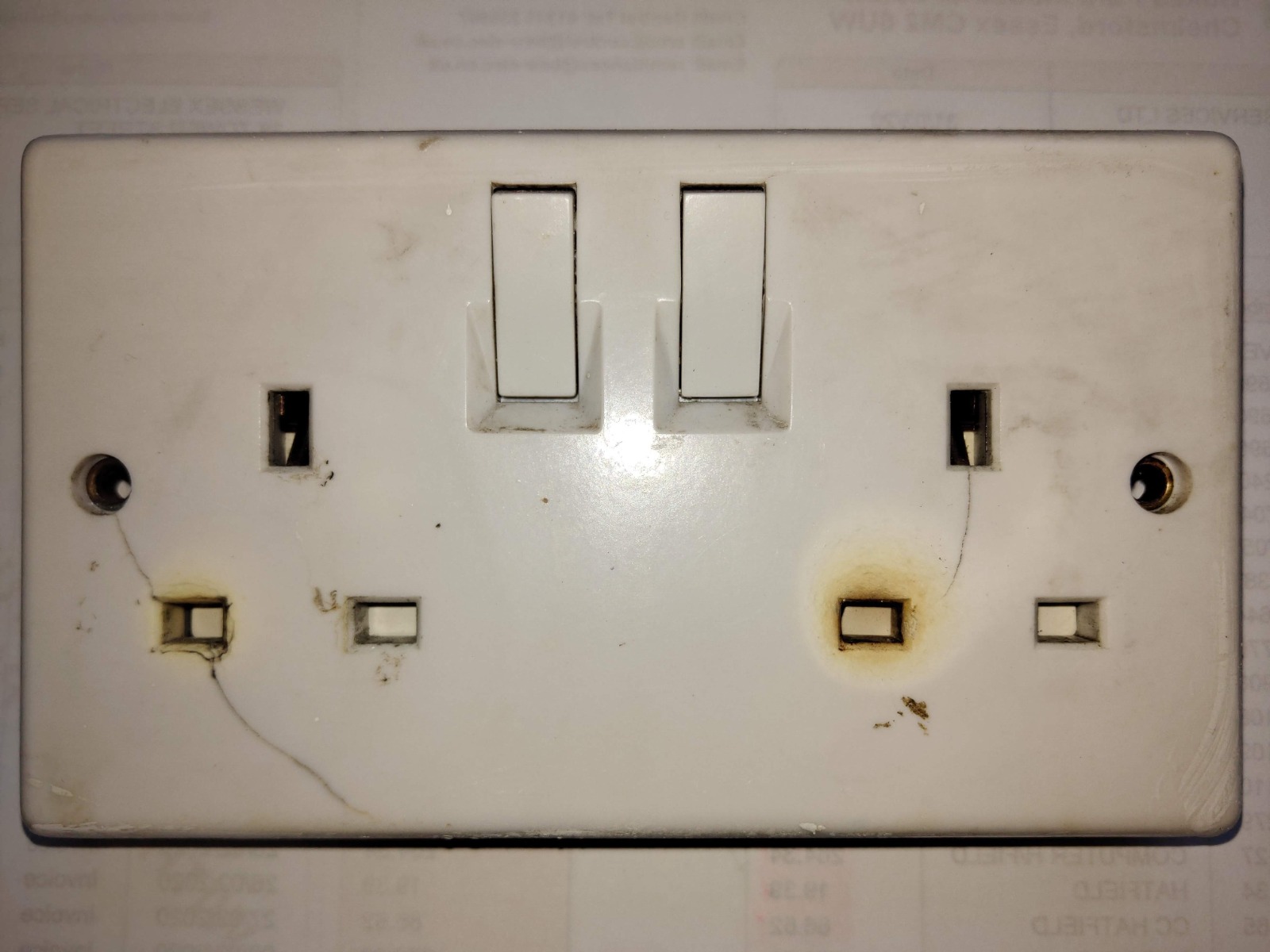
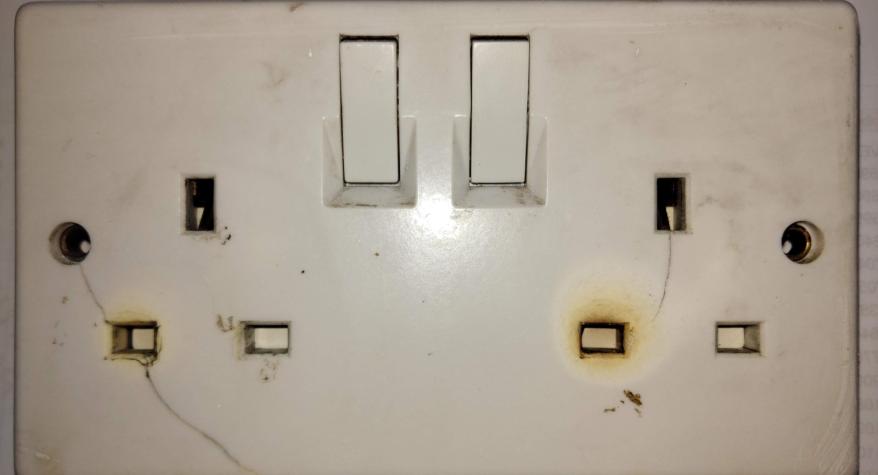
The heater plug and socket had suffered heat damage and had become stuck together.
The oil-filled heater had been running on its highest setting throughout the day, every day. Portable heaters place a sustained electrical load on a socket, particularly when operated at full output for long periods.
The burning smell was an important warning. Other signs of an overheating plug or socket can include:
- Discolouration around the socket
- A plug that feels unusually warm
- Crackling or buzzing
- Scorch marks
- A socket switch that becomes difficult to operate
- A plug that is difficult or impossible to remove
At this property, the plug had become fixed firmly enough that attempting to pull it out could have caused further damage. We left it in position until the circuit had been safely isolated.
How did WES remove the damaged equipment?
We isolated the affected circuit before removing the socket faceplate.
Fortunately, the faceplate screws remained accessible. This allowed us to remove the socket from the wall and disconnect it from the fixed wiring.
We then cut the damaged plug from the heater flex so that the socket and plug could be separated from the installation safely.
This controlled approach reduced the risk of damaging the conductors behind the socket. Pulling forcefully on a heat-damaged plug could loosen the socket, disturb the cable terminations or expose damaged components.
If a plug will not come out, switch off the appliance and socket if it is safe to do so. Do not prise it out with a tool or continue pulling against the socket.
Had the heat damaged the fixed wiring?
No. Our inspection found that the damage was limited to the socket and the heater plug.
Once the socket had been disconnected, we visually inspected the wiring behind it. The cable insulation, conductors and surrounding enclosure had not suffered heat damage.
This was an important part of the investigation. A new socket should not be fitted until the electrician has checked whether overheating has affected the cable or its terminations.
Where heat has travelled into a conductor, it may be necessary to cut back or replace the damaged section. In this case, that additional work was not required.
We also established that the problem was confined to the socket used by the heater. There was no indication that other socket outlets on the circuit had suffered the same damage.
What electrical tests were completed?
We inspected and tested the affected socket circuit before returning it to service.
The checks included:
- Continuity testing
- Insulation-resistance testing
- Polarity
- Earth-fault loop impedance, or Zs
- A check of the circuit’s protective device
- Visual inspection of the conductors behind the socket
The results allowed us to confirm that the fixed wiring could be returned to service after the damaged accessories had been replaced.
The installation was assessed as a complete circuit. Although the visible problem involved one plug and socket, testing was needed to confirm that the repair had left the protective arrangements and circuit intact.
What repairs did WES complete?
We replaced the heat-damaged socket and fitted a new plug to the portable heater.
Before restoring the supply, we completed the required inspection and testing and checked the new socket’s operation.
Power was then restored to the lounge socket circuit.
The heater could be plugged in again, but we also explained to the customer that a portable heater needs to be used in accordance with its manufacturer’s instructions. In this case, it had been operating at its highest setting throughout the day, every day.
Portable heaters draw a high load compared with many household appliances. Long periods of operation can expose weaknesses in a worn plug, socket or connection. The plug and socket should remain cool enough for normal operation and show no burning, distortion or discolouration.
Should a portable heater be used all day?
Check the heater manufacturer’s instructions and follow its operating guidance.
A portable heater may be useful for short-term or supplementary heating, but it should not be treated automatically as a permanent heating system. Its condition, rating and intended use all matter.
When using one:
- Plug it directly into a suitable wall socket
- Avoid extension leads and multiway adaptors unless the manufacturer expressly permits them and their ratings are suitable
- Keep the heater away from curtains, furniture and other combustible materials
- Do not cover it
- Check the plug and socket for heat or discolouration
- Switch it off when it is no longer needed
- Stop using it if you notice a burning smell, unusual noise or damaged cable
A heater operating normally does not prove that its plug and socket are in good condition. In this Fleet home, the heater was still receiving power even though heat damage had developed at the connection.
What should you do if a plug is stuck in a socket?
Switch off the appliance and socket, provided you can do so safely, and stop using them.
Do not keep moving the plug, force it out or remove the socket faceplate yourself. If there is smoke, significant heat or visible burning, isolate the circuit or main supply only if you can do so without approaching damaged equipment.
Arrange an electrical inspection if:
- A plug will not come out
- You can smell burning
- The socket or plug is discoloured
- The socket crackles or buzzes
- The plug becomes unusually hot
- The faceplate is cracked or distorted
- The circuit trips while the appliance is running
Leave the appliance disconnected after removal until its plug, flex and condition have been assessed.
What was the result for the customer?
The damaged socket and heater plug were replaced, the circuit passed the completed checks, and power was restored.
The customer also received practical guidance about using the portable heater. They understood that running it on its highest setting throughout each day placed a sustained load on the socket and that future use should follow the manufacturer’s instructions.
Because the customer acted when they noticed the burning smell, the damage was found before it spread beyond the plug and socket.
Socket repairs and electrical fault finding in Fleet
If you notice a burning smell, heat or discolouration around a plug or socket, stop using the affected equipment.
Wessex Electrical Services Ltd investigates damaged sockets, overheating plugs and electrical faults in Fleet, Alton and surrounding areas. We can isolate the fault, inspect the fixed wiring, complete the necessary repair and test the circuit before restoring power.
Call 01252 590250 to arrange an electrical inspection.